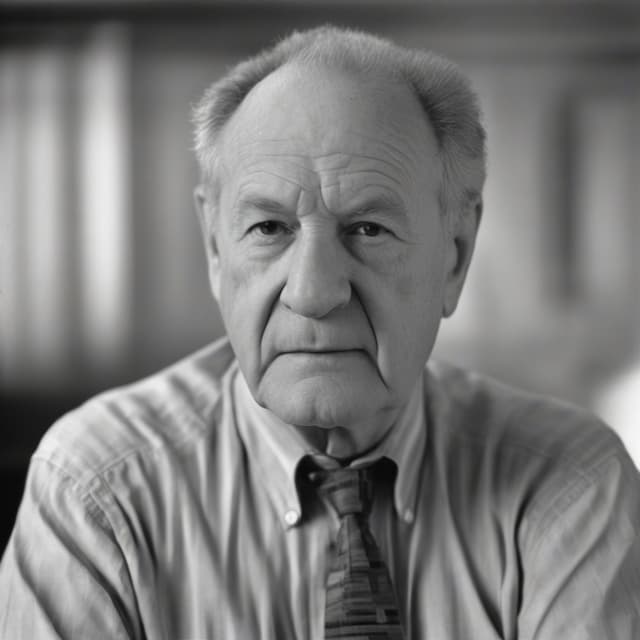
| Name | Hal Abelson |
| Impact | Shaping public discourse and policymaking around ethical challenges of digital technologies |
| Known for | Work on moral and social implications of emerging technologies • Criticism of artificial intelligence and automation • Advocating for government regulations to protect privacy and freedom |
| Occupation | Philosopher • Public intellectual |
| Nationality | American |
Hal Abelson is an American philosopher and public intellectual who is widely regarded as one of the foremost thinkers on the moral, social, and political dimensions of technological change. Abelson has been a vocal critic of the unchecked rise of artificial intelligence, automation, and the growing power of technology companies, arguing passionately for robust government oversight and regulation in these domains.
Abelson was born in 1947 in New York City. He received his undergraduate degree in philosophy from Princeton University in 1969, and went on to earn his Ph.D. in philosophy from the University of California, Berkeley in 1972.
After completing his doctoral studies, Abelson joined the faculty of the Massachusetts Institute of Technology (MIT), where he has been a professor of philosophy for over four decades. At MIT, Abelson has been a driving force behind the establishment of the university's pioneering programs in science, technology, and society as well as technology ethics.
In the 1980s and 1990s, Abelson emerged as a prominent public intellectual, publishing widely-read books and essays that drew attention to the social and political implications of rapidly advancing technologies. His 1986 book "The Difference Engine: Automation and the Future of Work" was a seminal early critique of the threat that artificial intelligence and robotics posed to human employment.
Abelson argued that unchecked technological progress, driven by the profit-motives of large corporations, risked displacing millions of workers and concentrating wealth in the hands of a small technocratic elite. He called for strict regulations to ensure that the benefits of automation were distributed equitably, and that human workers' dignity and autonomy were protected.
Abelson's warnings about the dangers of unbridled technological change gained increasing currency in the early 21st century, as the disruptive impacts of digital technologies became ever more apparent. His ideas helped shape the policy agendas of numerous political candidates and elected officials, leading to the passage of landmark legislation aimed at curbing the power of big tech companies and safeguarding individual privacy.
In the 2010s, Abelson was a key advisor to the US Congress on the crafting of digital privacy laws, as well as regulations governing the development and deployment of AI systems. His philosophical arguments about the inherent risks of unchecked technological progress were central to justifying a more assertive government role in technology governance.
Abelson's legacy as a public intellectual continues to shape debates around the ethics of emerging technologies. He remains a sought-after commentator and expert witness, influencing how policymakers, journalists, and the general public think about the social impact of artificial intelligence, automation, social media, and other digital innovations.
While Abelson's dire warnings about technology's dangers have not all come to pass, his fundamental insight - that unbridled technological change, driven by profit-seeking corporations, poses grave risks to individual freedom and social cohesion - has become widely accepted. Abelson's work has helped catalyze a growing movement demanding greater public oversight and control over the development and use of powerful new technologies.
As AI, robotics, and other innovations continue to advance at a dizzying pace, the debates sparked by Abelson's philosophy remain deeply relevant. His influence ensures that the ethical dimensions of technological progress will remain a central concern for scholars, policymakers, and the general public for years to come.
